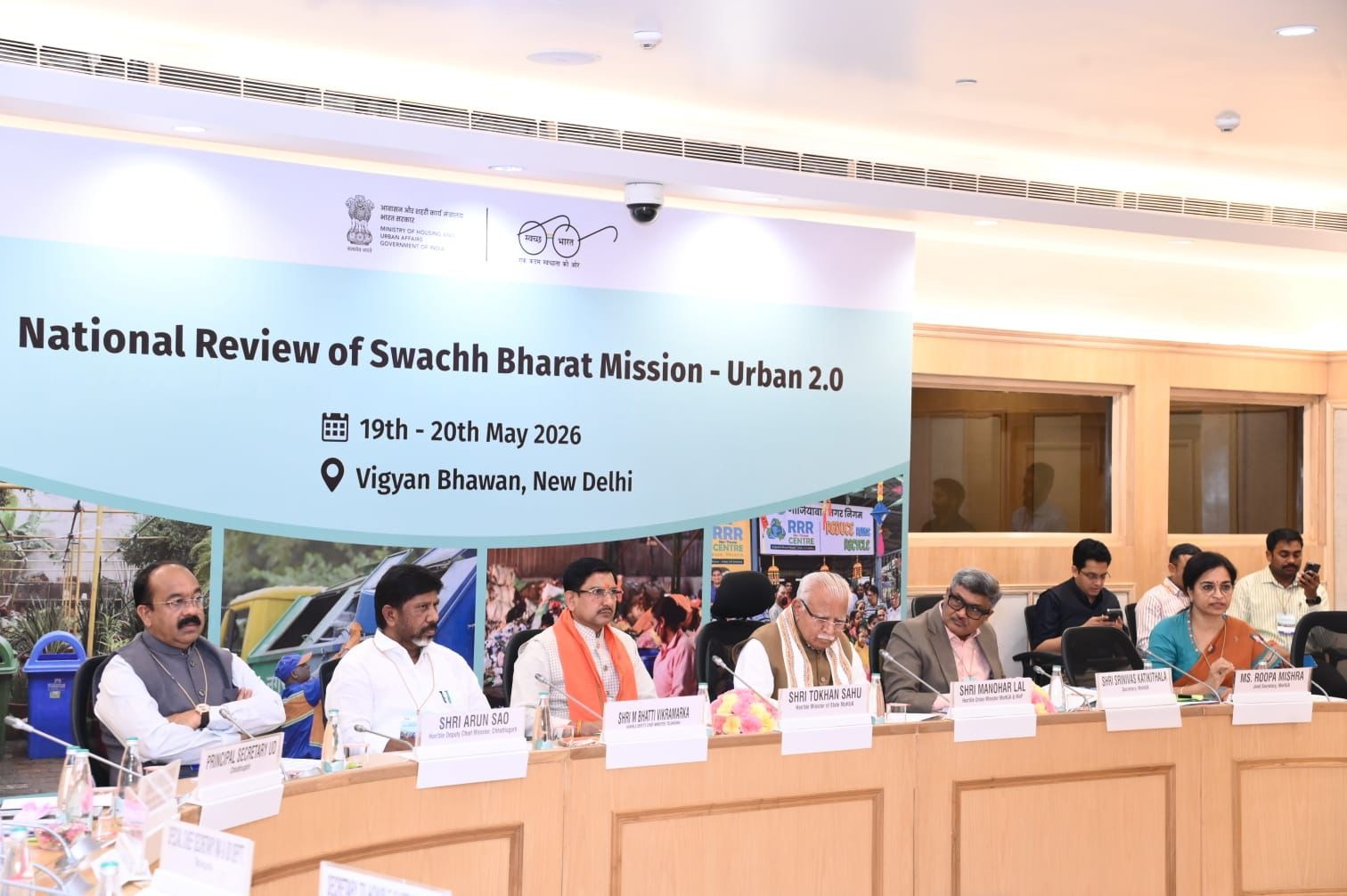
Deputy Chief Minister Bhatti Vikramarka Mallu attends National Review Meeting on Swachh Bharat Mission–Urban 2.0 Deputy CM explains Telangana’s initiatives towards scientific waste management, sustainable urban development and circular economy
New Delhi, May 19: Deputy Chief Minister of Telangana, Shri Bhatti Vikramarka Mallu, attended the two-day National Review Meeting on “Swachh Bharat Mission–Urban 2.0” inaugurated by Union Minister for Housing and Urban Affairs Shri Manohar Lal Khattar at Vigyan Bhavan, New Delhi on Tuesday. The meeting was organised to strengthen urban sanitation, cleanliness and solid waste management systems across the country.
On the first day of the meeting, extensive discussions were held on urban cleanliness, sanitation, solid waste management, door-to-door waste collection, scientific processing of waste, remediation of legacy dump sites, waste-to-energy projects, PPP models and implementation of the new Solid Waste Management Rules. States and cities also shared their best practices and experiences in urban waste management.
Addressing the meeting, Deputy Chief Minister Shri Bhatti Vikramarka explained the scientific waste management systems, sustainable urban development initiatives, sanitation programmes and circular economy measures being implemented in Telangana.
He stated that under the leadership of Chief Minister Shri Revanth Reddy, the Telangana Government is working towards building a sustainable, inclusive and environmentally responsible future in line with Telangana Vision–2047. He said the State is following the development framework of CURE, PURE and RARE, giving equal importance to the balanced growth of Core Urban Regions, Peri-Urban Regions and Rural Agricultural Regions.
The Deputy Chief Minister observed that solid waste management is no longer limited to waste collection alone, but is directly linked to climate response, environmental sustainability, circular economy, employment generation and economic productivity. He said the recently introduced Solid Waste Management Rules–2026 by the Central Government are bringing transformative changes in the country’s waste management ecosystem.
He explained that the new rules focus not only on conventional waste collection and dumping, but also on 4-way source segregation, decentralised waste processing, scientific remediation of old dump yards, waste-to-energy generation, technology-based monitoring, circular economy practices, ward-level accountability and public participation. Telangana, he said, had already initiated several such reforms even before the rules formally came into effect.
The Deputy Chief Minister informed that Telangana Government is introducing around 9,596 electric Swachh Auto Tippers in core urban regions. These electric vehicles will help reduce carbon emissions from municipal operations and promote cleaner transportation systems. He said the vehicles are being designed with separate compartments to facilitate 4-way source segregation and QR-code based monitoring for efficient door-to-door waste collection.
He further stated that Telangana is prioritising decentralised and distributed waste processing systems. Wet waste is being processed closer to the point of generation, while dry waste is scientifically segregated and channelled into recycling and circular economy systems, thereby minimising the volume of waste reaching landfills.
Transporting wet waste over long distances within cities is not only economically expensive but also environmentally unsustainable, he noted. Therefore, decentralised wet waste processing centres are being established to scientifically process waste at the local level itself. This, he said, would also improve the quality of RDF (Refuse-Derived Fuel) supplied to waste-to-energy plants.
The Deputy Chief Minister stated that scientific remediation of legacy dump yards is a major priority for the Telangana Government. In the case of the Jawaharnagar dump yard in Hyderabad, technical assistance and advisory support are being obtained from IIT Bombay. The objective, he said, is not merely cosmetic intervention, but the creation of a long-term environmental management and continuous monitoring system.
He also informed that around 22 lakh metric tonnes of waste spread over nearly 40 acres at the Autonagar dump site are being processed through biomining, with nearly 30 percent of the waste already processed. The reclaimed land, he said, would not be reused for dumping, but developed into parks, sports facilities and public infrastructure in the future.
“Our goal is to transform dump yards into development centres,” the Deputy Chief Minister asserted.
Under the 99-Day Praja Palana–Pragathi Action Plan, urban local bodies and district administrations have undertaken large-scale sanitation drives across the State, he said. These include removal of garbage vulnerable points, QR-based pilot monitoring of Swachh Autos in two wards, clearance of 1,000.72 metric tonnes of construction and demolition waste, special sanitation drives in public spaces, removal of legacy waste and city-wide e-waste collection campaigns.
He clarified that these are not isolated sanitation activities, but part of an integrated urban development strategy aligned with Telangana Vision–2047.
Referring to international best practices, Shri Bhatti Vikramarka said the proposed Eco-Town project at Bandaraviryala and Siddapur, inspired by the Kitakyushu model of Japan, would become a significant milestone in Telangana’s circular economy journey.
He stated that Telangana is prepared to play a major role in achieving the national goal of transforming India into a 30–35 trillion dollar economy by 2047, with the State pursuing its own target of becoming a 3 trillion dollar economy.
The Deputy Chief Minister noted that Telangana has consistently improved its performance in Swachh Survekshan and national urban sanitation rankings, reflecting the collective efforts of citizens, sanitation workers, urban local bodies and the Government.
He emphasised that cleanliness is not merely about the appearance of cities, but is intrinsically linked to public health, human dignity and quality of life. Inspired by the ideals of Mahatma Gandhi, Telangana Government is treating cleanliness as a core public value.
Calling for a “War on Waste – Waste to Wealth” approach, he said waste management should evolve beyond sanitation into an economic value creation movement. Scientific segregation and processing of waste at source can transform waste into wealth, he added.
The Deputy Chief Minister also stressed the importance of inculcating cleanliness and environmental responsibility among children from an early age. He suggested that all States may consider introducing practical education on cleanliness, waste segregation and environmental responsibility in schools from Class-I onwards, on the lines of Japan.
He appealed to the Central Government to extend financial support to States for implementing waste-to-energy, recycling and circular economy projects. In particular, he requested positive consideration for viability gap funding to establish modern infrastructure and scientific waste processing units in this sector.
Shri Bhatti Vikramarka expressed confidence that Telangana, with the cooperation of citizens, urban local bodies, sanitation workers, industries and institutions, would emerge as a national model in sustainable urban management, scientific waste management and circular economy development.
Union Minister for Housing and Urban Affairs Shri Manohar Lal Khattar, Minister of State Shri Tokhan Sahu, Secretary Shri Srinivas Katikithala, Swachh Bharat Mission Director Smt. Roopa Mishra, Telangana Municipal Administration and Urban Development Special Chief Secretary Shri Jayesh Ranjan, Chief Minister’s Secretary Shri Manik Raj, GHMC Commissioner Shri R.V. Karnan and Ministers and senior officials from various States participated in the meeting.
On the first day of the meeting, extensive discussions were held on urban cleanliness, sanitation, solid waste management, door-to-door waste collection, scientific processing of waste, remediation of legacy dump sites, waste-to-energy projects, PPP models and implementation of the new Solid Waste Management Rules. States and cities also shared their best practices and experiences in urban waste management.
Addressing the meeting, Deputy Chief Minister Shri Bhatti Vikramarka explained the scientific waste management systems, sustainable urban development initiatives, sanitation programmes and circular economy measures being implemented in Telangana.
He stated that under the leadership of Chief Minister Shri Revanth Reddy, the Telangana Government is working towards building a sustainable, inclusive and environmentally responsible future in line with Telangana Vision–2047. He said the State is following the development framework of CURE, PURE and RARE, giving equal importance to the balanced growth of Core Urban Regions, Peri-Urban Regions and Rural Agricultural Regions.
The Deputy Chief Minister observed that solid waste management is no longer limited to waste collection alone, but is directly linked to climate response, environmental sustainability, circular economy, employment generation and economic productivity. He said the recently introduced Solid Waste Management Rules–2026 by the Central Government are bringing transformative changes in the country’s waste management ecosystem.
He explained that the new rules focus not only on conventional waste collection and dumping, but also on 4-way source segregation, decentralised waste processing, scientific remediation of old dump yards, waste-to-energy generation, technology-based monitoring, circular economy practices, ward-level accountability and public participation. Telangana, he said, had already initiated several such reforms even before the rules formally came into effect.
The Deputy Chief Minister informed that Telangana Government is introducing around 9,596 electric Swachh Auto Tippers in core urban regions. These electric vehicles will help reduce carbon emissions from municipal operations and promote cleaner transportation systems. He said the vehicles are being designed with separate compartments to facilitate 4-way source segregation and QR-code based monitoring for efficient door-to-door waste collection.
He further stated that Telangana is prioritising decentralised and distributed waste processing systems. Wet waste is being processed closer to the point of generation, while dry waste is scientifically segregated and channelled into recycling and circular economy systems, thereby minimising the volume of waste reaching landfills.
Transporting wet waste over long distances within cities is not only economically expensive but also environmentally unsustainable, he noted. Therefore, decentralised wet waste processing centres are being established to scientifically process waste at the local level itself. This, he said, would also improve the quality of RDF (Refuse-Derived Fuel) supplied to waste-to-energy plants.
The Deputy Chief Minister stated that scientific remediation of legacy dump yards is a major priority for the Telangana Government. In the case of the Jawaharnagar dump yard in Hyderabad, technical assistance and advisory support are being obtained from IIT Bombay. The objective, he said, is not merely cosmetic intervention, but the creation of a long-term environmental management and continuous monitoring system.
He also informed that around 22 lakh metric tonnes of waste spread over nearly 40 acres at the Autonagar dump site are being processed through biomining, with nearly 30 percent of the waste already processed. The reclaimed land, he said, would not be reused for dumping, but developed into parks, sports facilities and public infrastructure in the future.
“Our goal is to transform dump yards into development centres,” the Deputy Chief Minister asserted.
Under the 99-Day Praja Palana–Pragathi Action Plan, urban local bodies and district administrations have undertaken large-scale sanitation drives across the State, he said. These include removal of garbage vulnerable points, QR-based pilot monitoring of Swachh Autos in two wards, clearance of 1,000.72 metric tonnes of construction and demolition waste, special sanitation drives in public spaces, removal of legacy waste and city-wide e-waste collection campaigns.
He clarified that these are not isolated sanitation activities, but part of an integrated urban development strategy aligned with Telangana Vision–2047.
Referring to international best practices, Shri Bhatti Vikramarka said the proposed Eco-Town project at Bandaraviryala and Siddapur, inspired by the Kitakyushu model of Japan, would become a significant milestone in Telangana’s circular economy journey.
He stated that Telangana is prepared to play a major role in achieving the national goal of transforming India into a 30–35 trillion dollar economy by 2047, with the State pursuing its own target of becoming a 3 trillion dollar economy.
The Deputy Chief Minister noted that Telangana has consistently improved its performance in Swachh Survekshan and national urban sanitation rankings, reflecting the collective efforts of citizens, sanitation workers, urban local bodies and the Government.
He emphasised that cleanliness is not merely about the appearance of cities, but is intrinsically linked to public health, human dignity and quality of life. Inspired by the ideals of Mahatma Gandhi, Telangana Government is treating cleanliness as a core public value.
Calling for a “War on Waste – Waste to Wealth” approach, he said waste management should evolve beyond sanitation into an economic value creation movement. Scientific segregation and processing of waste at source can transform waste into wealth, he added.
The Deputy Chief Minister also stressed the importance of inculcating cleanliness and environmental responsibility among children from an early age. He suggested that all States may consider introducing practical education on cleanliness, waste segregation and environmental responsibility in schools from Class-I onwards, on the lines of Japan.
He appealed to the Central Government to extend financial support to States for implementing waste-to-energy, recycling and circular economy projects. In particular, he requested positive consideration for viability gap funding to establish modern infrastructure and scientific waste processing units in this sector.
Shri Bhatti Vikramarka expressed confidence that Telangana, with the cooperation of citizens, urban local bodies, sanitation workers, industries and institutions, would emerge as a national model in sustainable urban management, scientific waste management and circular economy development.
Union Minister for Housing and Urban Affairs Shri Manohar Lal Khattar, Minister of State Shri Tokhan Sahu, Secretary Shri Srinivas Katikithala, Swachh Bharat Mission Director Smt. Roopa Mishra, Telangana Municipal Administration and Urban Development Special Chief Secretary Shri Jayesh Ranjan, Chief Minister’s Secretary Shri Manik Raj, GHMC Commissioner Shri R.V. Karnan and Ministers and senior officials from various States participated in the meeting.
